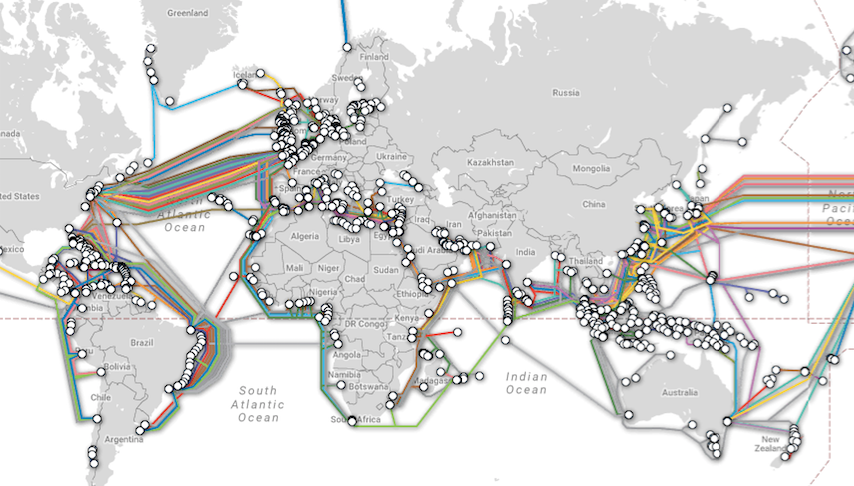
The Internet is the term we use for the physical network of servers, wires, fibre optic cables and wifi that we use along with the “backbones” that make it possible such as undersea cables, landing stations and signal amplifiers. I have given an example of the scale of the “Backbones” that expands across continents in the picture below.
The World Wide Web was created by Sir Tim Berners-Lee, it is platform used with the Internet as a way to link on document directly to another. It is different to the Internet as the Internet is the infrastructure and the WWW is a service on top of that Infrastructure.
Types of Coding and what they are for…
Types of “coding” or an easier to understand term “computer language”. This computer language enables computers to understand each other across the world without language and cultural boundaries.
A few examples of the different coding terms are as follows:
HTML (Hyper Text Markup Language) html has the function to structure and format documents enabling it to link to other resources and documents.
CSS (cascading Style Sheets) css is how HTML elements are displayed, cascading. css is used for presentational purposes, such as text, images and the general feel of the website.
Javascript is the coding used for the behavioural aspect of the website such as how the user can interact with the site and the interactivity like hoover over features, scrolling features and animation.
Hardware and software needed…
The hardware you need to use the internet and to access the world wide web has the following minimum requirements:
Landing station – to connect to the country you are in.
Signal amplifier – to boost signal along Cables
Fiver optic cables – to transport the information
Servers and data farms – to receive information and distribute to you
Computer – to receive information, it must be internet enabled
The Software you need to use the internet and to access the world wide web has the following minimum requirements:
An operating system – to process and deliver information in user friendly format
Internet browser – to be used to browse the internet and discover URLs.
Why use CSS…
CSS is a clean code, making it easy for browsers to read. CSS allows cross platform adaptation, again making it available from further sources, CSS is SEO friendly , allowing your site to be found easily. CSS is compatible with HTML.
Why use HTML…
HTML is mainly used for the structure of the site. HTML has video and audio support. HTML supports office browsing which can be a real benefit to your site, allowing to view content without an internet connection. HTML is SEO friendly. HTML is easy to keep your website maintained and updated. HTML has cross browser compatibility.

 Ed' Favourite Food